Tailbone pain (coccydynia) makes much more sense once you can see what is happening. This guide walks through it in pictures, one step at a time (moving diagrams and slides), with links to the full articles if you want to go deeper.
Key points
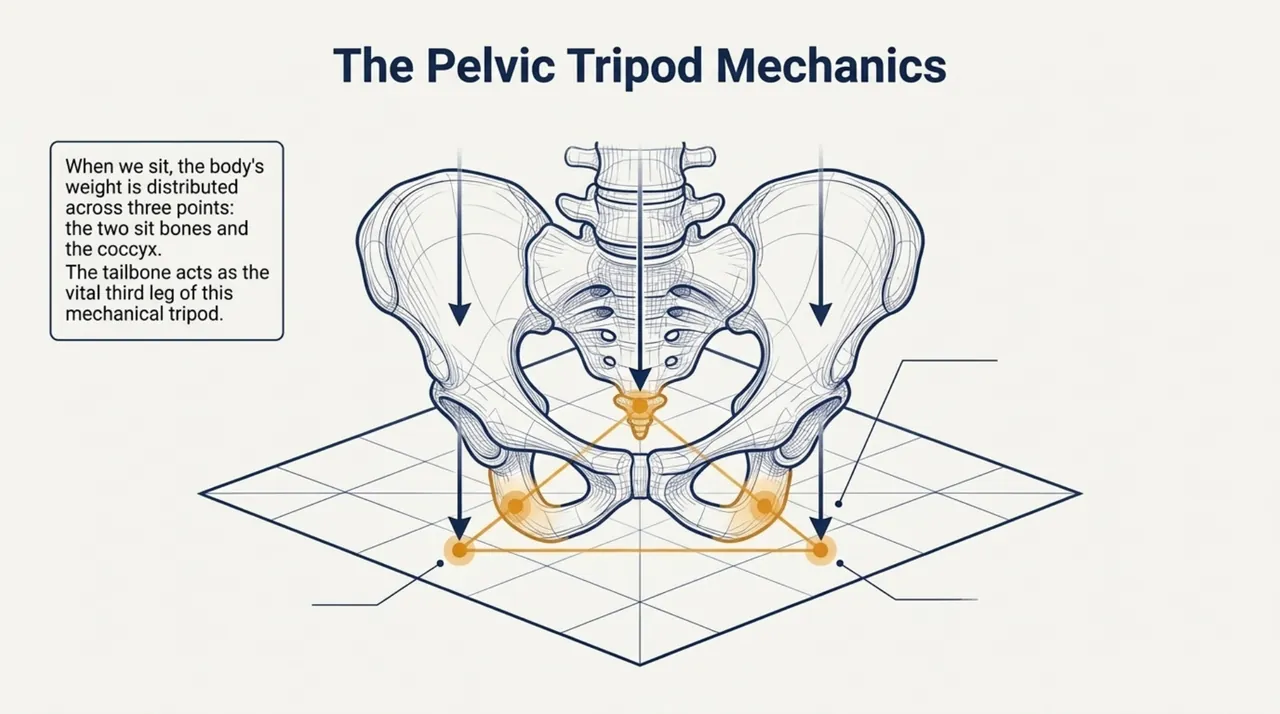
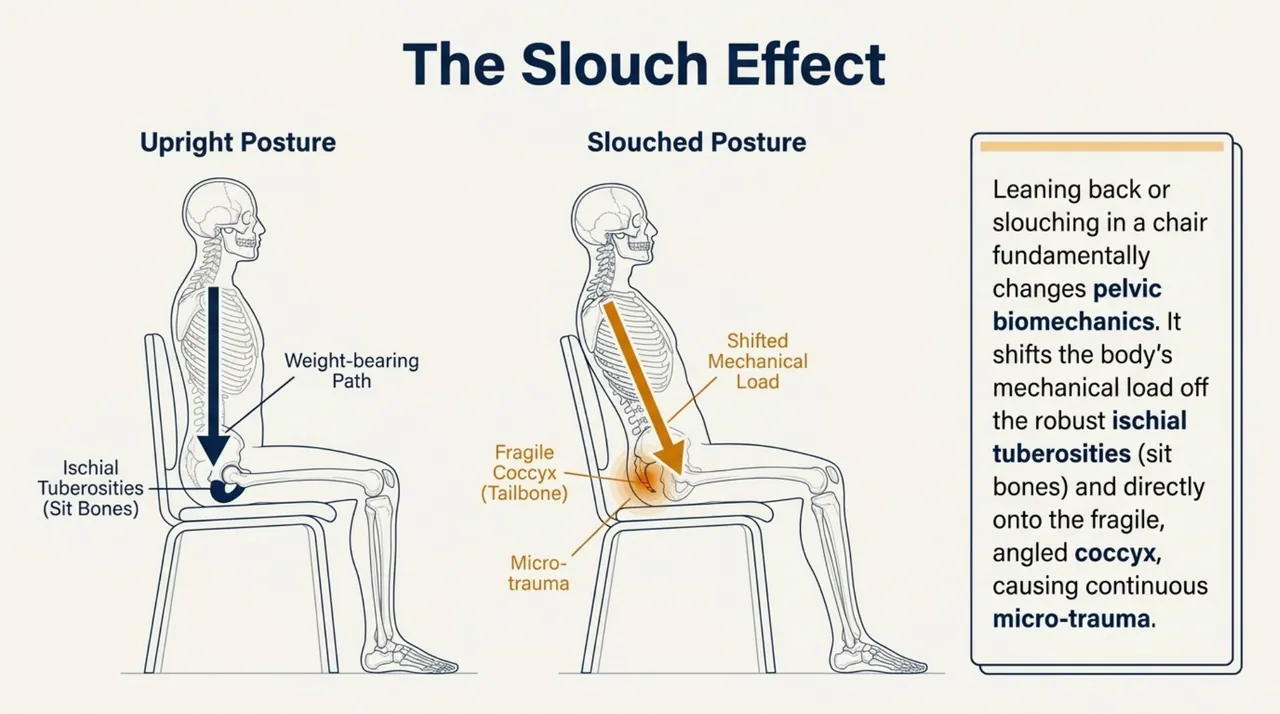
- When you sit, your weight rests on two sitting bones. Leaning back or slouching adds the coccyx as a third point, and that is when it hurts.
- The coccyx is a small anchor for the pelvic floor muscles, the buttock muscle and several ligaments, so it is never just "a leftover bone".
- Pain usually comes from a fall, childbirth or repeated strain such as long sitting or riding over bumps.
- True coccydynia is pain you can point to with one finger, worst when sitting and when getting up.
- Sitting and standing X-rays compared side by side can show a coccyx that bends too far or slips. In one large study they found a likely cause in about 7 in 10 people.
- About 9 in 10 people get better without surgery.
1. A small bone with a big job
The coccyx is made of three to five small segments at the very bottom of the spine, joined to the sacrum above it. It is small, but it is an anchor point. The pelvic floor muscles that support the bladder and bowel attach to it, as do fibres of the large buttock muscle (gluteus maximus) and strong ligaments that tie it to the pelvis.
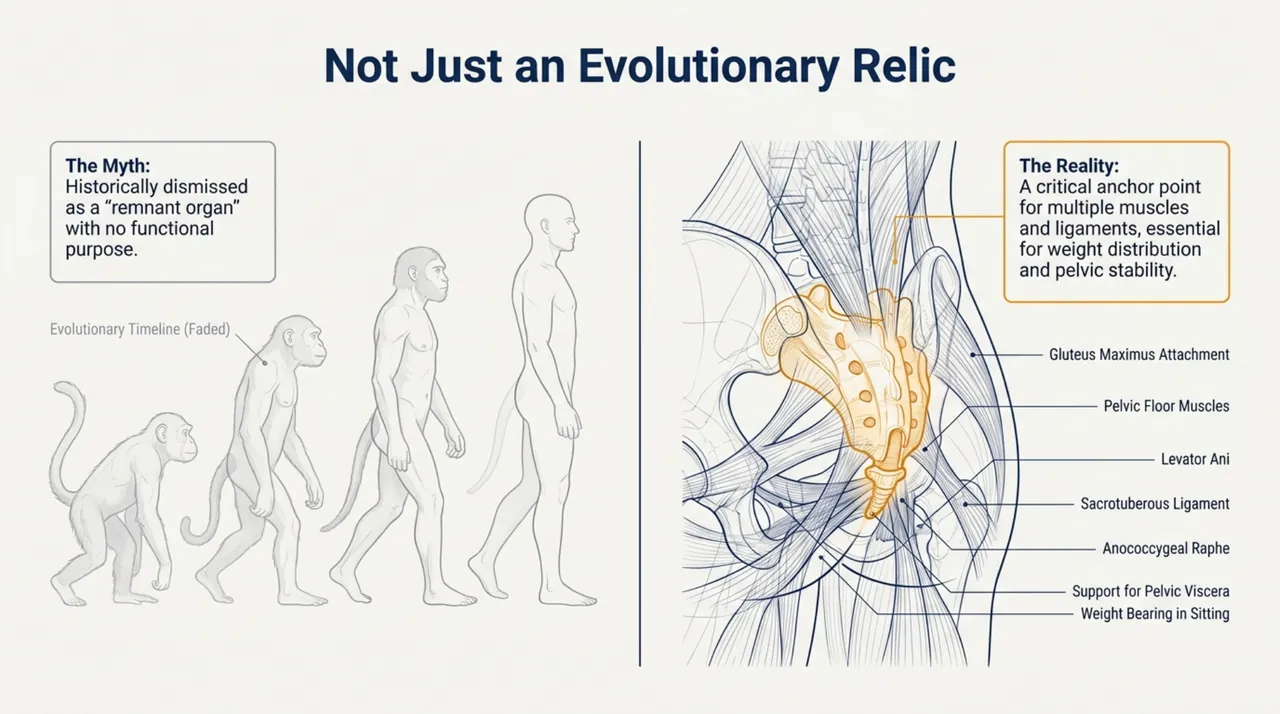
That is why tailbone pain is often more than a bone problem. Tight or overworked pelvic floor muscles can pull on the coccyx, and a painful coccyx can make those muscles tense up in turn.
2. Why sitting hurts: the tripod
Sit up straight and your weight rests on the two sitting bones (the ischial tuberosities), with the coccyx held clear of the seat. Lean back, slouch or sink into a soft sofa, and the pelvis rolls backwards. Now the coccyx becomes the third leg of a tripod, and it is not built to carry that load.
This is why the simplest advice works so often: sit tall or lean slightly forward, and use a cushion with a gap at the back.
Read more: 8 ways to sit more comfortably with tailbone pain
3. Not every coccyx is the same shape
Some coccyges curve gently, others hook sharply forward, and in some the joint is already slightly out of line. Shape alone doesn't cause pain, but it changes how pressure is spread when you sit, so some people are more likely to develop problems.
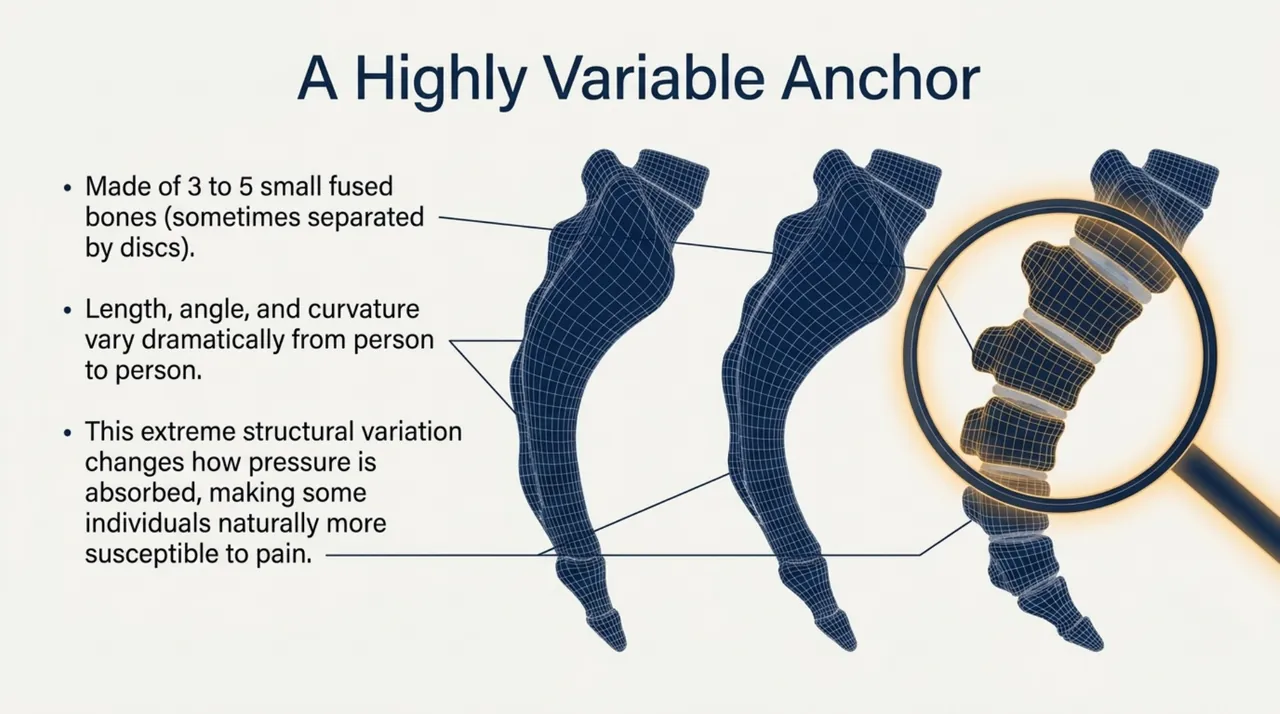
Read more: Why some tailbones hurt and others don't
4. How the coccyx gets hurt
| Route | Examples | What tends to happen |
|---|---|---|
| A sudden blow from outside | A fall onto the bottom on stairs, a wet floor or ice; a hard landing on a ride or water slide | Bruising, a sprain of the joint, a fracture or a joint that slips out of line |
| Pressure from inside | Childbirth, especially a difficult or assisted delivery | The coccyx is pushed backwards and the joint and ligaments are strained |
| Repeated strain | Long hours sitting, especially slouched; two-wheeler riding over bumps; cycling or rowing | Small, repeated overload that builds up without a single injury |
| Body weight at either end | Higher weight changes how the pelvis tilts when sitting; very low weight leaves little padding | Either can increase the load on the coccyx |
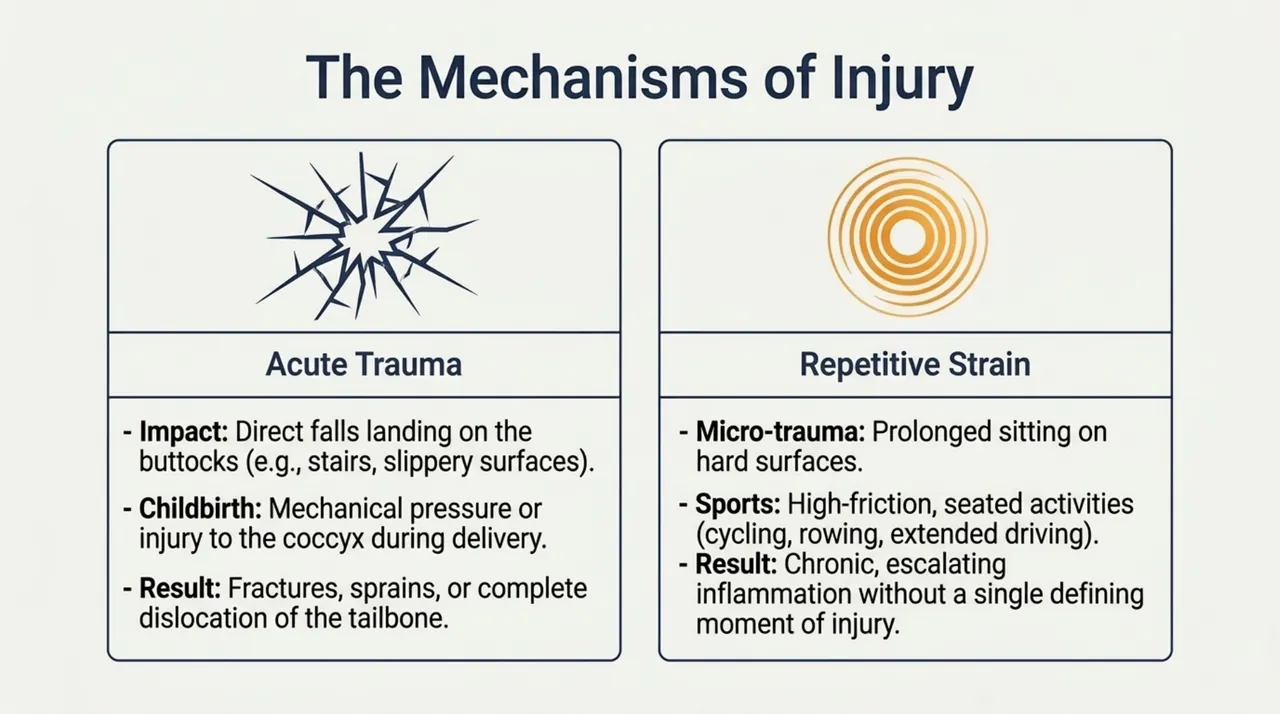
Read more: Tailbone pain after having a baby · Two-wheelers, potholes and tailbone pain · Does body weight affect tailbone pain?
5. Recognising it
True coccydynia has a clear pattern:
- Pain right at the base of the spine, in the midline, that you can point to with one finger.
- Worse when sitting, especially leaning back, and often a sharp jab when getting up from a chair.
- Sometimes worse when opening the bowels or during intercourse, because the coccyx sits close to the back passage.
Pain mainly in one buttock, pain shooting down the leg, or numbness and tingling usually point somewhere else.
6. Is it really the coccyx?
| Coccydynia | Pelvic floor muscle pain | Pain from the lower back | |
|---|---|---|---|
| Where | The tip of the tailbone, in the midline | Deeper and more spread out; pressure in the back passage or vagina | Lower back, often spreading into the buttock or down the leg |
| Set off by | Sitting, leaning back, getting up | Stress, bladder or bowel problems, long sitting | Bending, lifting, long standing or sitting |
| Nerve signs | None | None | Sometimes tingling, numbness or weakness in the leg |
| What helps | Taking pressure off the coccyx; hands-on treatment of the joint | Relaxing and releasing the pelvic floor muscles | Treatment directed at the spine |
A few less common conditions can feel similar, and some need other treatment. If you have fever, bleeding from the back passage, pain that is constant even at rest or at night, or unexplained weight loss, see a doctor promptly.
Read more: Pain near the tailbone that isn't coming from the coccyx · When tailbone pain needs urgent attention
7. Seeing the problem: sitting and standing X-rays
An ordinary X-ray is taken lying down or standing, when no weight is on the coccyx, so it often looks normal. The French physician Jean-Yves Maigne developed a simple comparison: one side-on X-ray standing and one sitting. Comparing the two shows how the coccyx behaves under your weight.
In Maigne's study of 208 people with coccydynia, the two pictures showed a likely cause in about 7 in 10. A coccyx that bent too far (hypermobile) and a joint that slipped backwards were the most common findings. Backward slips were more common in people with a higher body weight, and small bony spurs at the tip in slimmer people.
Imaging is not needed for everyone. Most of the information comes from your history and a careful examination, and an X-ray is added when it will change the treatment.
Read more: What happens at a coccydynia consultation
8. Which way has it moved?
When the coccyx is out of line, the direction matters. A coccyx pushed inwards and one pushed outwards need different hands-on treatment, which is why it is checked before anything is done.
Read more: A displaced tailbone: why the direction of the shift matters
9. Treatment, step by step
Treatment starts with the simplest, safest steps and moves up only if needed:
- Take the pressure off. Sit tall or lean slightly forward, take breaks, and use a wedge or U-shaped cushion with the gap at the back.
- Hands-on treatment. Treatment of the coccyx joint and release of the tight muscles around it, by a clinician trained in coccyx problems, with exercises to keep it moving well.
- Medicines for short-term relief, when your doctor advises them.
- Injections or nerve blocks, such as a ganglion impar block, for pain that persists despite the earlier steps.
- Surgery to remove the coccyx, kept for a small number of carefully selected people because of its real risk of wound problems.
About 9 in 10 people improve with the first, non-surgical steps.
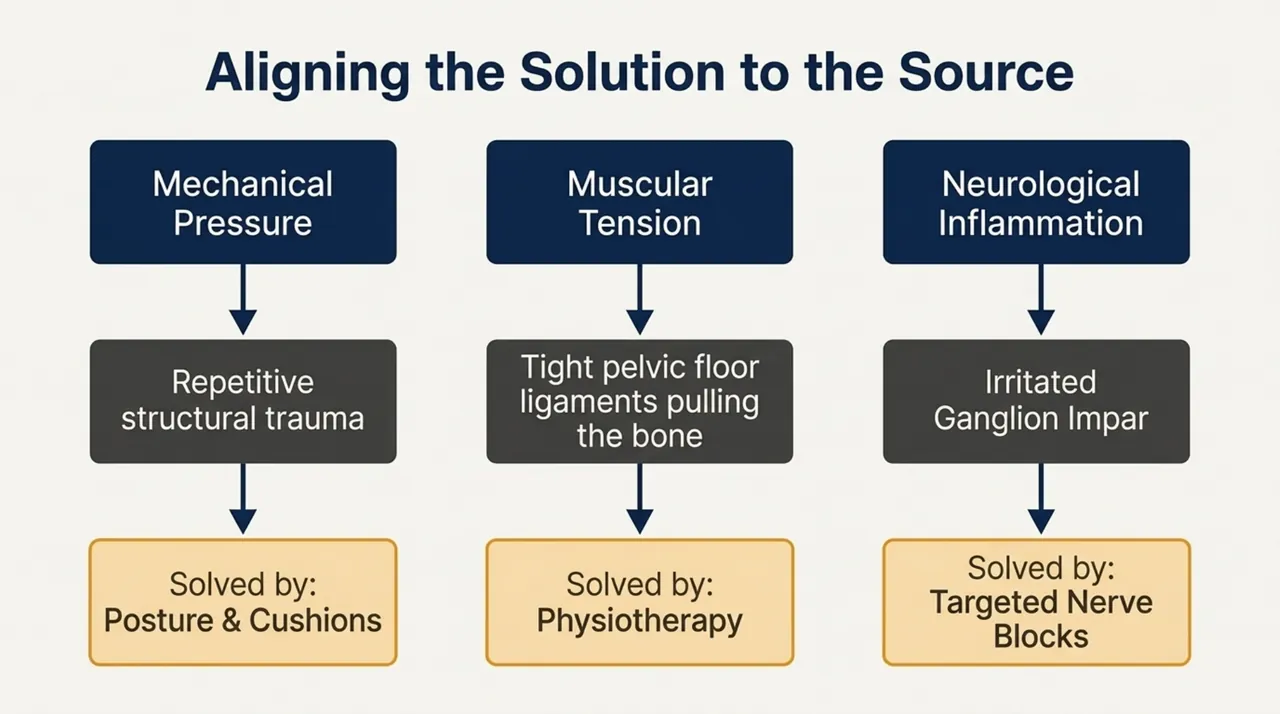
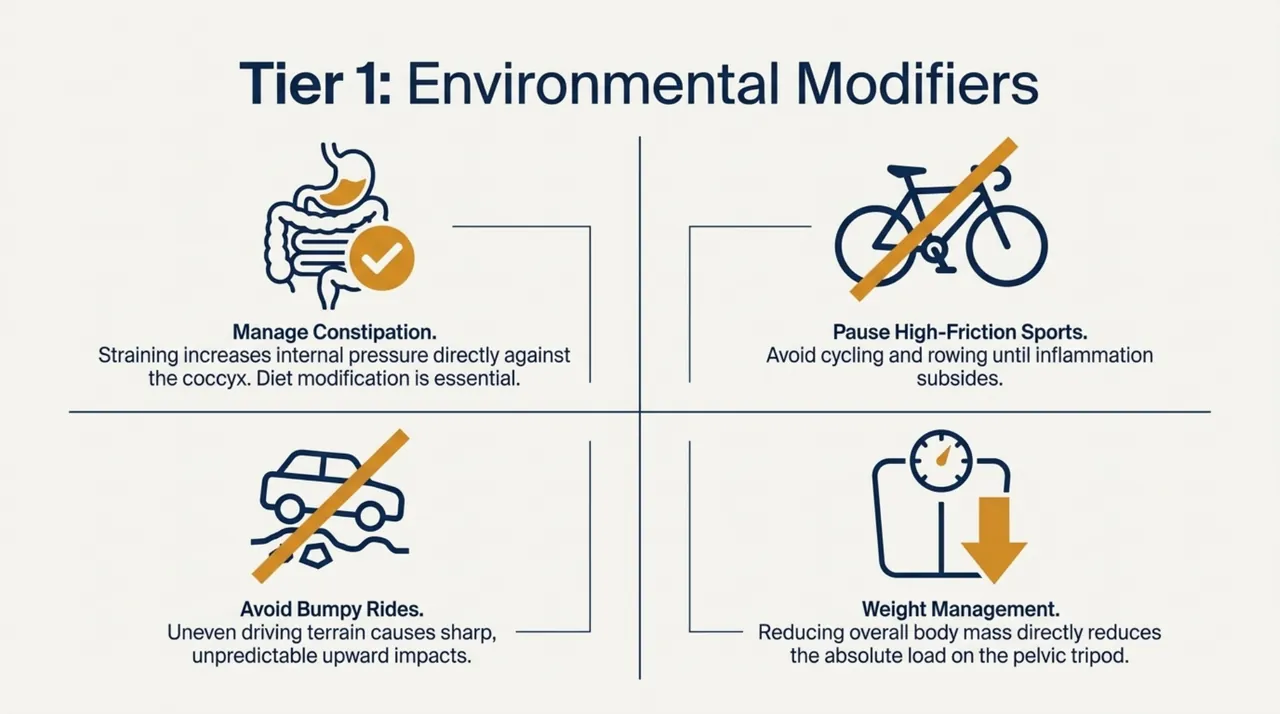
Read more: How coccydynia is treated · Why "bone setting" can be dangerous
Summary
Tailbone pain is a mechanical problem with a clear pattern, and it can be worked out. Find out exactly where the pain comes from, take the load off the coccyx, treat the joint and the muscles around it, and step up only if needed. Most people get back to sitting comfortably without surgery.
Sources
- Maigne JY et al. Causes and mechanisms of common coccydynia: role of body mass index and coccygeal trauma. Spine. 2000;25(23):3072–3079
- Garg B, Ahuja K. Coccydynia: a comprehensive review on etiology, radiological features and management options. J Clin Orthop Trauma. 2021;12(1):123–129
- Lirette LS et al. Coccydynia: an overview of the anatomy, etiology, and treatment of coccyx pain. Ochsner J. 2014;14(1):84–87
- Postacchini F, Massobrio M. Idiopathic coccygodynia: analysis of fifty-one operative cases and a radiographic study of the normal coccyx. J Bone Joint Surg Am. 1983;65(8):1116–1124
- MSD Manual Professional: Coccyx disorders (Foye PM, reviewed 2024)